

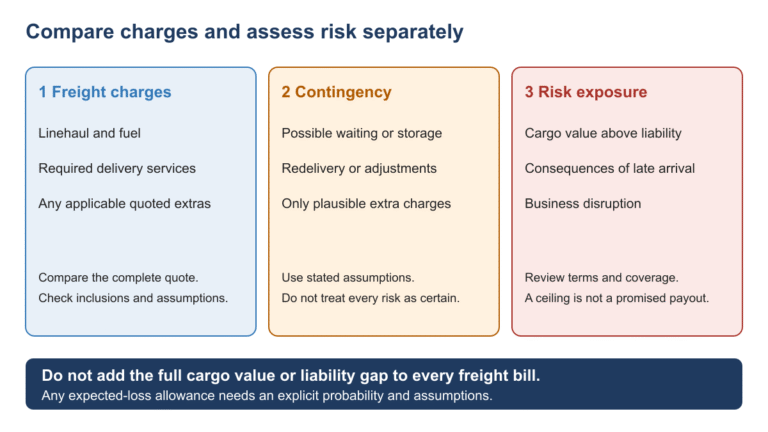
Choose an LTL carrier by comparing the complete expected freight charge, including fuel, required services and reasonable allowances for possible adjustments. Assess cargo loss and delivery disruption separately as business risks. The full value of an uninsured shipment is not automatically a shipping expense, and the carrier with the lowest base rate may not have the lowest complete quote.
A business comparing less-than-truckload (LTL) carriers can receive several apparently similar prices. Later, an invoice may include an unrequested service, a delivery window may be missed, or a damage claim may reveal that the carrier’s liability is below the goods’ value. Each problem calls for a different check before booking.
These outcomes can sometimes be anticipated, but they are not all certain or equally likely. This guide separates freight charges from contingency allowances and cargo risk, then shows how to compare two complete quotes.
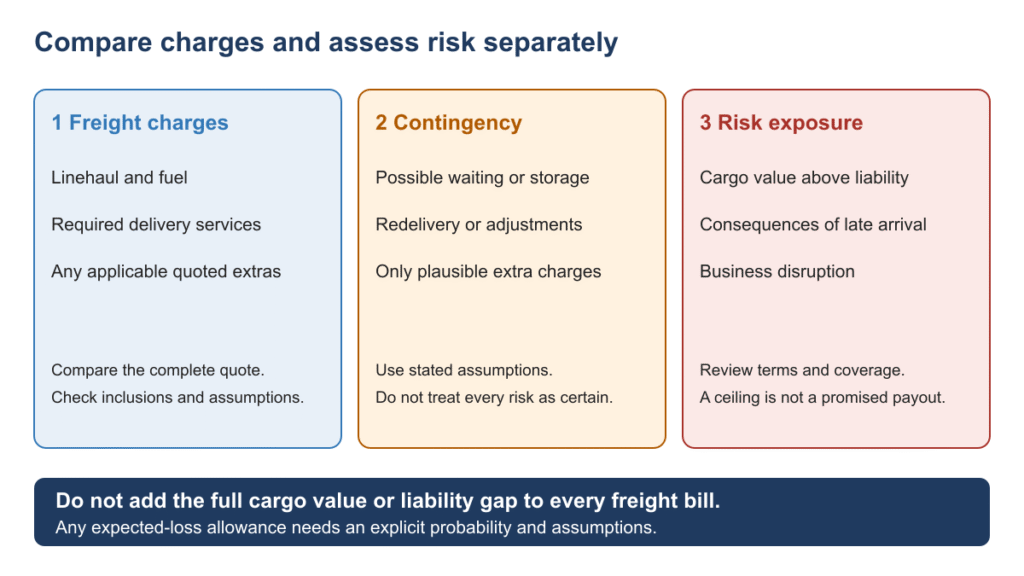
Compare freight charges, contingency allowances and cargo or delay exposure separately; the full liability gap is not an automatic shipping expense.
What Is Total Shipment Cost?
For budgeting, separate three items: confirmed or estimated carrier charges, a contingency for plausible extra charges, and the financial impact of loss or delay. Do not add the entire cargo value or liability gap to every shipment’s freight bill. A risk allowance, if used, needs an explicit probability and assumptions; it is different from a quoted charge.
Freight Charges and Risks to Review
1. Linehaul rate
This is the carrier’s charge for moving the freight between the two locations. Canadian carriers rate it from weight, space and distance under their own tariffs, and many apply a minimum density, so a light but bulky pallet can be rated as if it were heavier.
2. Fuel surcharge
Fuel is usually a percentage added to the linehaul and adjusted on a schedule, often weekly, according to a published diesel price table. Because each carrier uses its own table, two quotes with similar base rates can end up with noticeably different fuel amounts.
3. Services you request
Tailgate service at a site without a dock, a delivery appointment, residential delivery and inside delivery may be priced separately or included in a service package. If the receiver needs them, they belong in the comparison from the start.
4. Charges that appear after the fact
Some charges are triggered by what happens on the day. Published Canadian tariffs include waiting time once loading or unloading runs past a free-time allowance, redelivery after a failed attempt, and storage that begins after a short free period. Even when their occurrence is uncertain, ask for the applicable rates, free-time allowances and triggers before booking.
5. Adjustment risk
Carriers can inspect, reweigh and re-measure freight under the agreed terms. Accurate dimensions and gross weights reduce avoidable discrepancies; they do not eliminate tariff changes, legitimate service additions or billing errors. Keep measurement evidence and check any adjustment against the contract.
6. The liability gap
Carrier liability is not cargo insurance. Quebec’s heavy-vehicle user guide describes a $4.41-per-kilogram default indicated value unless another value is recorded on the bill of lading. Ontario’s general-freight conditions also contain a weight-based limit. Liability depends on the applicable law, contract and circumstances; a limit does not guarantee payment of a claim.
Illustrative example: assume an entire 300 kg shipment worth $9,000 is lost, carrier liability is established, and a $4.41-per-kilogram limit applies with no different agreed value. The ceiling would be $1,323, leaving $7,677 above that ceiling. That is potential loss exposure, not an automatic freight charge. Discuss an accepted declared value and its terms with the carrier, or separate cargo insurance with an insurer; exclusions, deductibles and claim requirements still matter.
7. Delay and team time
A missed appointment can mean a rebooking fee from the receiver, an idle crew, or a lost sale. Hours spent chasing status updates by phone are also a cost, even though no invoice shows them.
How Do You Compare Two Carriers on Total Cost?
Line up the layers you can price and add an honest estimate for the ones you cannot. The example below uses invented figures purely to show the arithmetic.
Illustrative example (hypothetical figures, not real rates): Quote A has the lower base rate but a higher fuel percentage, and it leaves out the delivery appointment the receiver requires. Quote B includes it.
| Cost layer | Quote A | Quote B |
|---|---|---|
| Base linehaul | $390.00 | $430.00 |
| Fuel surcharge | 40% = $156.00 | 26% = $111.80 |
| Tailgate at delivery | $85.00 | $85.00 |
| Delivery appointment | Not quoted, added later: $70.00 | Quoted: $60.00 |
| Expected total | $701.00 | $686.80 |
Quote A looked $40 cheaper on the base rate. Once fuel and the missing appointment are counted, Quote B comes out $14.20 lower. The numbers are hypothetical, but the calculation shows why every required service belongs in the comparison.
Which Non-Price Factors Deserve Weight?
Two carriers with similar totals can still differ a great deal in what you experience after booking. Weigh these factors alongside price:
- Service record: on-time history and ratings from other shippers, where available.
- Claims handling: how quickly claims are acknowledged and settled, and what documentation the carrier expects.
- Communication: whether you get status updates without asking and can reach dispatch when plans change.
- Coverage on your lane: whether the carrier serves both postal codes directly or hands the freight to a partner, which can add time.
- Equipment: whether a tailgate truck is available when the receiver has no dock.
Making the Comparison Practical
Pricing every layer by phone is slow, which is why many shippers use a platform that puts quotes and service information in one view. Truxweb’s LTL quote comparison platform, built mainly for businesses in Quebec and Ontario, lays out each carrier’s rate, estimated transit and rating together, and after booking it sends status alerts and lets you message carrier dispatch directly. It still pays to confirm that the services your receiver needs are included for each shipment before you book.
Conclusion
Choosing an LTL carrier on total shipment cost means pricing what the quote shows, anticipating what the invoice can add, and accounting for what the business absorbs. Ask every carrier the same questions, include the services the receiver really needs, and decide how you will cover the value of the goods. A low base rate alone does not establish the lowest complete cost or the best fit for your shipment.
Frequently Asked Questions
What costs are often missing from an LTL quote?
Services triggered on the day, such as waiting time, redelivery and storage, plus any adjustment after a reweigh or re-measure. Services the receiver needs but nobody requested, like an appointment, are another frequent gap.
Is declared value the same as cargo insurance?
No. An accepted declared value can change the liability limit under the contract, often for a charge; it does not remove all conditions or exclusions. Cargo insurance is a separate policy with its own terms, exclusions and claims process.
How often do fuel surcharges change?
It depends on the carrier. Many adjust weekly against a published diesel price, while some use monthly averages. Ask how the percentage on your quote was set and when it next changes.
Should I always book the highest-rated carrier?
Not automatically. Ratings are one input. Balance them with total cost, transit estimate, coverage on your lane and how critical the delivery date is.