

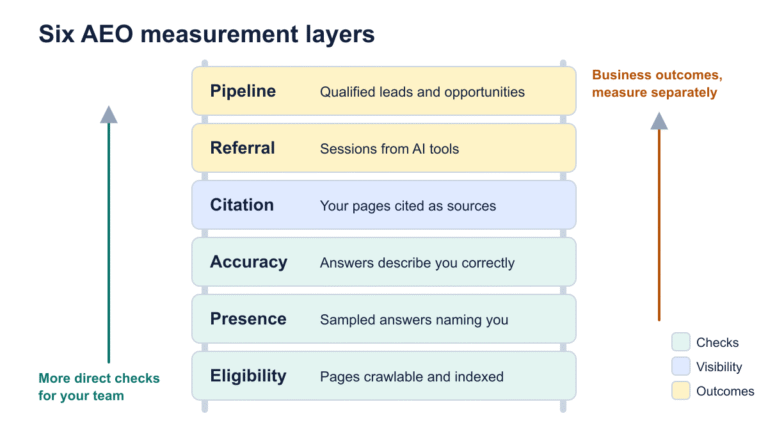
AEO measurement should cover technical eligibility, observed visibility and business outcomes separately. Track whether key pages can be crawled and indexed, how often your brand appears in a repeatable prompt sample, whether answers describe you accurately, how often your pages are cited, how many visits AI tools send, and how many of those visits become qualified leads. Report each level separately, measure a baseline first, and write targets as ranges.
Answer engine optimization has a measurement problem that SEO went through years ago. Early SEO reports were full of rankings for terms nobody searched and traffic that never converted. AEO reports can fall into the same trap with screenshots of a brand named in ChatGPT, or a single “AI visibility score” that nobody can explain.
The fix is the same as it was then. Decide which outcomes the business cares about, connect them to measures you can collect reliably, and accept that some links in the chain are easier to measure than others.
Six measurement layers to track separately. This framework is not a fixed sequence or proof of causation.
Start With the Business Question
Before choosing metrics, write down what the program is meant to change. For most B2B companies the honest answer is some mix of three things: being considered when buyers research the category, being described correctly when they do, and turning some of that research into conversations with sales.
Each goal implies different evidence. Consideration shows up as presence in answers to category questions. Correct description shows up in accuracy checks. Conversations show up in analytics and the CRM. A program that measures only the first goal can look successful while sales sees nothing change.
The Outcome Ladder
It helps to picture AEO outcomes as a ladder. This is a planning framework, not a fixed sequence or a causal funnel. Access and content checks are more directly manageable than buyer behaviour, but mentions, citations and leads can move independently and at different speeds.
| Rung | Example metric | Where the data comes from | Leading or lagging |
|---|---|---|---|
| Eligibility | Priority pages crawlable, indexed and open to search bots | Search Console, server logs, robots.txt review | Leading |
| Presence | Share of sampled answers that name the brand | Your prompt sample | Leading |
| Accuracy | Share of answers describing the brand with no detected factual errors | Your prompt sample, reviewed by a person | Leading |
| Citation | Citations of your pages; your share of citations | Prompt sample, Bing Webmaster Tools | Middle |
| Referral | Sessions from AI tools | Web analytics | Lagging |
| Pipeline | Qualified leads and opportunities from AI-influenced visits | CRM, self-reported attribution | Lagging |
Eligibility
Direct citations of your own pages depend on the relevant provider’s access and eligibility rules. Brand mentions can also come from third-party coverage, even when your own pages are inaccessible. Check Google’s current technical requirements and Search generative AI control; crawl access and indexing alone do not guarantee inclusion. Other platforms run their own crawlers, so check that the search crawlers you want, such as OAI-SearchBot and PerplexityBot, are not blocked by accident.
Presence and accuracy
Presence is the share of sampled answers that name you. Accuracy is the share that describe you correctly. Track both together, because rising presence with falling accuracy is a problem, not a win.
Citation
Citations show which of your pages an assistant presents as references; that alone does not prove how a page affected its claims. Bing Webmaster Tools now offers a preview metric called Citation Share, defined as the percentage of citations attributed to your site out of all citations shown for a given grounding query. Microsoft calls it an observational metric rather than a ranking or a competitive scoreboard, which is a sensible way to read any citation figure.
Referral and pipeline
Referral sessions are the first rung where the business can see behavior. Identify referral sessions using the sources and campaign parameters actually recorded in your analytics, and test the collection setup. Some AI-assisted research will not leave an identifiable referral. Pipeline is the hardest rung to measure, because buyers often read an answer and then arrive later through a branded search or a direct visit. An optional “how did you hear about us” field on demo forms captures some of the influence that analytics misses.
Set a Baseline You Can Repeat
Measure every rung before changing anything. Use the same prompt list, the same engines and the same number of runs per prompt each time, and save the raw answers. Generated answers vary from run to run, so a baseline built on one run per prompt will make normal variation look like progress or decline.
Write Targets as Ranges
Single-number targets invite arguments about noise. Ranges are easier to defend. The example below uses invented numbers for illustration only.
A company tracks 40 prompts and runs each one 5 times on two engines, which gives 400 answers per cycle. At baseline, the brand appears in 60 of them, or 15 percent. The team repeats baseline cycles to estimate normal variation rather than deciding in advance that a small change is just noise. It sets a six-month target range of 20 to 25 percent presence, which is 80 to 100 of the 400 answers, alongside an illustrative accuracy floor of 90 percent among answers that actually describe the brand. Report that denominator separately from all 400 sampled answers.
Metrics That Look Good but Mislead
A few common measures deserve caution:
- Raw mention counts with no denominator. Fifty mentions means little without knowing how many answers were sampled.
- One blended score across all engines. Engines retrieve and cite differently, so a blend can hide a drop on the platform your buyers use most.
- Branded prompts counted as visibility. If the prompt names your company, being mentioned is expected. Use branded prompts to check accuracy, not presence.
- Platform figures read as market share. Each report covers only its own surfaces, and your prompt sample is not all AI usage.
Agree on Reporting Before Work Starts
Whoever runs the program should report every rung separately, monthly, with the definitions attached. That applies whether the work stays in-house or goes to a done-for-you provider such as GoBlinkly, which handles AEO execution alongside SEO and content work for B2B brands and includes visibility tracking. Agree in writing what counts as a mention, how many runs make up a sample, and which analytics views count as AI referrals.
Conclusion
Measurable AEO outcomes come from a chain, not a single score. Keep the lower rungs healthy, watch the middle rungs for direction, and judge the program by the upper rungs over a period long enough for buying cycles to play out. Keep mentions, citations, referrals and qualified leads on separate lines so that progress in one is never mistaken for progress in all.
Frequently Asked Questions
What is the most important AEO metric?
The one closest to revenue that you can measure reliably, usually qualified leads or opportunities influenced by AI research. Presence and citation are useful observations even when a lead cannot be attributed to them. Movement in one metric does not establish that it caused movement in another.
How long before AEO metrics change?
It varies by category, competition and starting point. Eligibility fixes can show up quickly in crawl data, while presence and pipeline usually take longer. Set review points rather than deadlines.
Should AI visibility and SEO be tracked separately?
Track them side by side. The same foundations support both, and Google says SEO best practices remain relevant for its AI features, but the outputs and reports differ.
Can a small team measure AEO without paid tools?
Yes. A spreadsheet prompt sample, Search Console, Bing Webmaster Tools and web analytics cover most rungs. Paid tools add scale, but clear definitions matter more than tooling.