

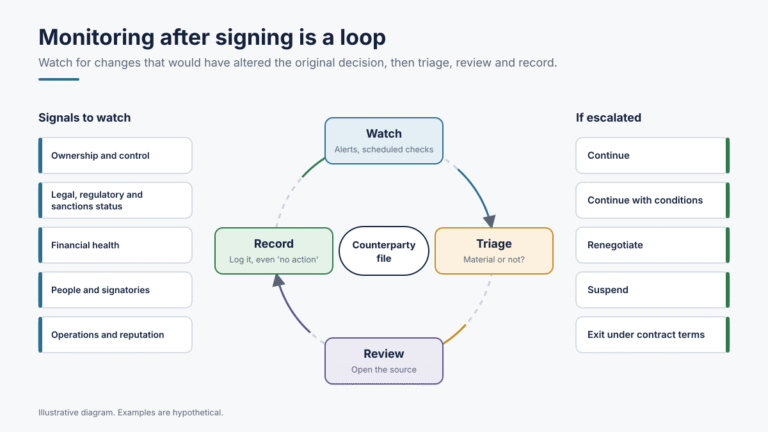
Counterparty monitoring after signing means watching for changes that would have affected your original decision: ownership and control, legal and sanctions status, financial health, key people and reputation. Set the review interval according to risk and your own policy, use alerts between reviews, keep a dated record of every change and what you did about it, and agree in advance which changes go straight to a decision-maker.
On signing day, the due diligence file is often at its most complete. Ownership has been checked, sanctions screening is clear, the financials have been reviewed and the references have been taken. From then on, the file starts to age.
Contracts can run for years, and the company on the other side does not stand still. It may be sold, take on new debt, lose its finance director, enter a dispute or be named in a sanctions action. None of that will show up in a file that nobody reopens. This guide covers what to watch, how often to look, what evidence to keep and how to decide when a change needs a decision.
After signing, monitoring runs as a loop: watch for changes, triage what matters, review the evidence, then escalate or record the decision.
Why Does Counterparty Risk Change After Signing?
Onboarding checks describe a company as it was on a particular date. The risks you accepted were based on that picture. When the picture changes, the risk you are carrying can change too, even if the contract has not.
Some changes are routine and harmless. Others might have stopped the deal had they existed at the start. The job of post-signing monitoring is to tell the two apart quickly and to leave a record showing that you did.
Which Changes Are Worth Watching?
Group the signals by what they could mean for you, not by where they come from.
Ownership and Control
New shareholders, a change of control or a new parent company can trigger change-of-control clauses, alter sanctions exposure or move decision-making to a different country. In the UK, the free Companies House Follow service emails you when a company you follow files something, which can surface officer and ownership filings.
Legal, Regulatory and Sanctions Status
Watch for sanctions designations, enforcement actions, insolvency filings, licence changes and significant litigation. Sanctions lists change over time, so screening should run against current list data rather than the version checked at onboarding. OFAC’s Sanctions List Service offers downloads of both the Specially Designated Nationals (SDN) List and the Consolidated (non-SDN) List.
Financial Health
Late filings, new secured borrowing, going-concern warnings and changes in payment behaviour can point to strain. For US public companies, material events appear in a Form 8-K current report, which companies generally have four business days to file.
People
Changes to directors, signatories and your day-to-day contacts can matter more than they seem. A new owner of the relationship on their side may not know what was agreed.
Operations and Reputation
Security incidents, site closures, product recalls and credible adverse media can affect your customers as well as your counterparty.
How Often Should You Review Each Counterparty?
Match the depth of review to the risk the relationship carries. The intervals below are illustrative starting points only. The right interval depends on your policy, your sector, the relationship and, for regulated firms, your regulator’s expectations.
| Risk tier | Example relationships | Full review | Between reviews |
|---|---|---|---|
| High | Critical suppliers, exclusive distributors, payment partners, cross-border joint ventures | For example, annually and after any trigger | Ongoing alerts on ownership, sanctions, legal events and adverse media |
| Medium | Material contracts that could be replaced with effort | For example, every one to two years | Alerts on sanctions and major legal events |
| Low | Routine, easily replaced relationships | For example, at renewal | Scheduled sanctions screening |
The “between reviews” column matters because a change can happen at any point in the year. A full review held once a year would not, on its own, pick up a sanctions designation made a few months after the last review.
What Evidence Should You Keep?
Keep a simple monitoring log for each counterparty. Each entry should record:
- The date the change was seen and the source, with a link or saved copy
- What changed, in one sentence
- The assessment: no impact, watch, or escalate
- The decision made and who made it
- The date the entry was closed
Record the “no action” decisions too. A log that shows a change was seen, assessed and judged harmless is better evidence than silence, because it shows the process ran.
When Should a Change Be Escalated?
Decide the escalation triggers before you need them. Examples include a potential sanctions match, a change of control, an insolvency filing, a serious enforcement action and any incident involving your data or customers.
For each trigger, name who hears about it and how fast. One possible path runs from the relationship owner to risk or compliance, then to legal, then to whoever holds authority over the contract. The outcome can be one of a small set of options: continue, continue with conditions, renegotiate, suspend or exit under the contract’s terms.
Escalation is easier when the contract supports it. Notification duties, audit rights and termination rights can all make post-signing changes easier to act on, so involve legal colleagues when the contract is drafted, not only when something goes wrong.
Keeping Monitoring Sustainable
Alert fatigue is one way monitoring can fade. Filter signals by materiality, group alerts by counterparty instead of by source, and send a short periodic summary to the people who own the relationships.
Scheduled research tools can carry some of the watching between reviews. Grep by Parcha Labs builds custom AI agents that can run checks on a schedule and return each finding with its source.
Whatever does the watching, the reviewer’s job stays the same. Open the source, confirm it relates to the right legal entity, and decide whether the change touches something in the contract. Treat a finding that cannot be traced to a dated source as unconfirmed until someone checks it.
Conclusion
Signing a contract closes onboarding, not risk. Watch for changes that would have affected your original decision, set review intervals by risk and policy, log every change with its source and outcome, and agree escalation rules before you need them. If someone later asks what you knew and when, the file should be able to answer.
Frequently Asked Questions
What is counterparty monitoring?
It is the ongoing review of the companies you have contracts with, looking for changes in ownership, legal status, finances, people or reputation that could affect the relationship.
How is it different from onboarding due diligence?
Onboarding is the initial due diligence carried out before a relationship begins, which may involve several checks and follow-ups. Monitoring looks for change afterwards, for as long as the relationship lasts.
How often should counterparties be rescreened against sanctions lists?
It depends on your policy and, where relevant, your regulator. Some organisations rescreen when lists are updated, others on a fixed schedule, and higher-risk relationships may be checked more frequently.
What should trigger an immediate review?
Examples include a potential sanctions match, a change of control, an insolvency filing, a serious enforcement action or an incident that affects your data or customers.
Who should own counterparty monitoring?
One arrangement is for the relationship owner to handle day-to-day awareness, with risk or compliance setting the rules and legal advising on contractual options.