

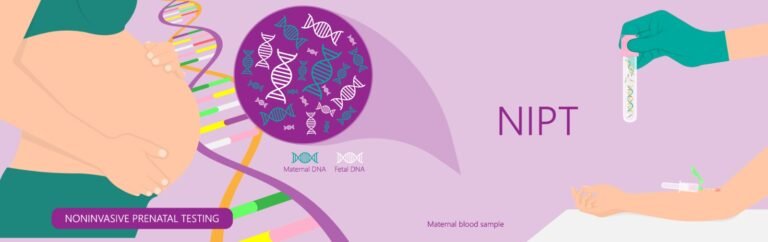
Hey mama-to-be, feeling overwhelmed with all the different scans and tests you’re asked to take? It’s completely natural to have so many questions running through your mind. One such test your doctor may recommend is the NIPT test and you might be wondering why it’s done and what it actually screens for. In this blog, we’ll walk you through what NIPT is, how it works, what it can and cannot detect, and how it helps you make informed decisions for your pregnancy journey.
What Is NIPT (Non-Invasive Prenatal Testing)?
Non-Invasive Prenatal Testing (NIPT) is a relatively easy process that involves taking a sample of blood from pregnant women and analyzing it for possible presence of certain chromosomal abnormalities like Trisomy 21 (Down syndrome), Trisomy 18 (Edwards syndrome) and Trisomy 13 (Patau syndrome).
Please note that NIPT is a screen test rather than a diagnostic one. This means that it provides an estimation of possible chromosomal abnormalities but can neither diagnose nor determine all genetic problems.
NIPT can be also called cell-free DNA screening or non-invasive prenatal screening (NIPS). As this procedure is optional, your doctor will help you to decide if it should be performed during your pregnancy.
What Conditions Can NIPT Detect?
NIPT does not screen for all chromosomal conditions or birth disorders. Most standard NIPT panels focus on detecting a few common chromosomal abnormalities, including:
- Down syndrome (Trisomy 21)
- Trisomy 18
- Trisomy 13
- Conditions involving the sex chromosomes (X and Y)
These conditions occur due to an extra or missing chromosome. For example, Down syndrome, Trisomy 18, and Trisomy 13 are caused by an additional chromosome. Screening of the sex chromosomes can also provide information about the baby’s sex and identify differences in the number of X or Y chromosomes.
Some of the more common sex chromosome conditions include Turner syndrome, Klinefelter syndrome, Triple X syndrome, and XYY syndrome.
It’s also important to know that not all NIPT tests cover the same conditions. The scope of screening can vary depending on the panel you choose, so it’s always best to speak with your healthcare provider to understand exactly what your test includes.
Can NIPT Detect All Genetic Disorders?
NIPT is not a comprehensive genetic test. It does not examine the baby’s entire genetic makeup, which means there are clear limitations to what it can detect.
While NIPT is highly accurate for the conditions it screens, it does not identify:
- Many single-gene (inherited) disorders
- Structural birth defects
- Several rare genetic conditions
- All types of chromosomal abnormalities
NIPT focuses on analysing chromosomal number changes, rather than looking at every gene in detail. Since it uses DNA fragments from the placenta (not the baby directly), it provides a probability-based result, not a complete diagnosis.
How Accurate Are NIPT Tests?
The accuracy of NIPT varies according to the ailment being screened. Certain variables, such as being pregnant with twins or multiples, being a surrogate, or being overweight, can also have an impact on the outcome.
For example, NIPT is around 99% accurate in detecting Down Syndrome, but slightly lower for disorders such as Trisomy 18 and Trisomy 13. Overall, compared to standard prenatal screening tests such as the quad screen, NIPT produces fewer false-positive results, making it a more dependable screening alternative.
Final Thoughts:
Pregnancy comes with so many decisions, and it’s completely okay to feel a little unsure along the way. NIPT is a safe, simple, and helpful screening test that can give you early insights into your baby’s health. But it’s important to remember it’s not a complete or confirmatory test. It’s just one piece of the bigger picture. Think of it as a first step towards understanding your baby better, not the final answer. Depending on your results and personal situation, your doctor may guide you towards further testing or simply reassure you. And if you’re still exploring your options, you can consider LifeCell Diagnostics for reliable NIPT screening, helping you take a more informed step in your pregnancy journey.