

Residential proxies have become essential tools for businesses and individuals who need reliable, undetectable access to web data. By masking your real IP address with one assigned to a real household, they make your activity appear completely legitimate to websites.
This guide explains how residential proxies work, why they’re valuable, and how solutions like Evomi leverage real user IPs to deliver better performance and trust.
How Residential Proxies Actually Work
The process is simpler than most explanations suggest:
- You request a webpage or resource.
- Your request routes through a real residential IP address.
- The target website sees a genuine home user.
- Content returns through the same route.
- You receive unrestricted access without detection.
The entire cycle happens within milliseconds. Websites never distinguish between you and a real household user—because the IP address they see belongs to one.
Residential vs Other Proxy Types
Proxies are intermediaries that route your requests through different IP addresses so that your real IP remains concealed from the target website and the source of your request. With respect to your IP, here’s what you’re looking at:
| Proxy Type | IP Source | Speed | Detection Risk | Cost | Best For |
| Residential | Real home devices | Medium-High | Very Low | $3–$5/GB | Scraping, streaming |
| Datacenter | Hosting servers | Very High | High | $0.50/GB | Basic browsing |
| Mobile | Cellphone networks | Medium | Lowest | $6–$10/GB | High-security tasks |
| Static | Fixed addresses | Consistent | Medium | $10+/mo | Account management |
These proxies win for most tasks because sites see them as everyday users from ISPs like Comcast or Verizon.
Why Businesses Rely on Them
Residential proxies dodge blocks where others fail:
- Authentic traffic: 95%+ success on tough sites like Amazon.
- Geo-targeting: Pick cities/states for local prices or ads.
- Scalability: Pools of 10M+ IPs handle massive volumes.
- Compliance: P2P-sourced, often GDPR-friendly.
No more CAPTCHA walls or bans—data flows clean.
Real-World Use Cases
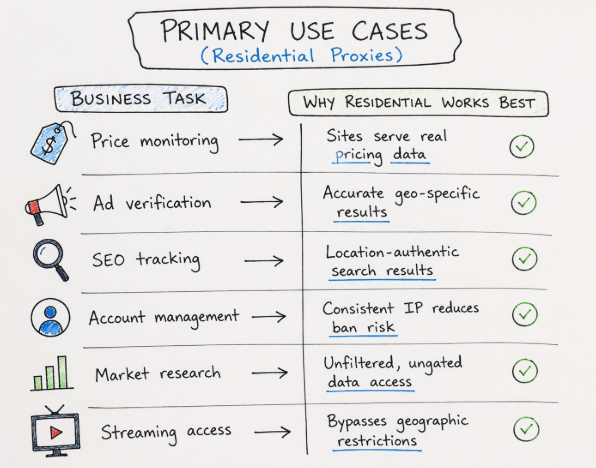
Residential proxies are widely used across industries:
Common Applications:
- E-commerce: Monitor prices across different regions
- Ad Verification: Check how ads appear in various locations
- Social Media Management: Handle multiple accounts safely
- Market Research: Collect reviews and competitor data
With Evomi real user IPs, businesses can operate across all 50 U.S. states with precise ISP-level targeting.
Overview of Rotating vs. Sticky Session
Rotating sessions will continuously change IP addresses based on either request level frequency or constant time period intervals of use and work best for activities such as scraping, researching, and other high volumes of data collection, where being too uniform gives each browser less chance of being detected.
The use of sticky sessions provides for the same IP address to be used for extended periods of time (usually 10 to 30 minutes). This type can be used for logging into an account, submitting forms, or any type of function that calls for a consistent identity across multiple pages that the same user may have.
Some reputable service providers, like Evomi, support both options, working simultaneously on the same account.
FAQs
Q: Are residential proxies legal to use?
A: Yes, typically for legitimate reasons, including research, monitoring, or geo-validation, but always read the target website’s terms of service before using a residential proxy.
Q: How are Evomi’s IPs different from other providers?
A: Residential IPs from Evomi are sourced from real users, through ethical means, resulting in lower detection risk and the potential for legal issues than those sourced on the grey market.
Q: How much data do typical tasks consume?
A: Light web browsing uses 1-5 GB per month, typical scraping activity will use 20-50 GB/month, while high-volume use cases will require 100+ GB/month in data planning.
Q: Why do residential proxies cost more than datacenter proxies?
A: Due to the challenges of ethically sourcing and maintaining reliable residential IP addresses, there is a premium for genuine investment in infrastructure as opposed to simple branding.
Q: Can one provider handle multiple business tasks?
A: Yes. Configure rotating sessions for scraping and sticky sessions for account management within the same provider account.
Bottom Line
Residential proxies work because they rely on real-world infrastructure—actual home IP addresses assigned by ISPs. This makes them:
- More reliable
- Harder to detect
- Better suited for professional use
Solutions like Evomi take it further with real user IPs, combining performance, compliance, and scalability.
If your goal is seamless access, accurate data, and fewer blocks, residential proxies are the clear choice.