

There is a certain moment every Toronto driver knows. You pull up at a light on King Street West, and a matte black SUV slides up beside you. No chrome. No paint job you can name. Just this deep, clean finish that somehow looks more intentional than anything that came out of a factory. You find yourself staring. And then the light turns green, and you are left wondering what exactly that was.
That design you’re seeing more often on the road isn’t paint. It’s a car vinyl wrap. Across Toronto, from the Gardiner Expressway to the streets of Yorkville, more drivers are choosing this option to transform the look of their vehicles.
While the idea isn’t new, the rising popularity of car vinyl wrap in Toronto reflects a shift in how people approach customization. Instead of committing to a permanent paint job, vehicle owners are opting for a flexible, reversible solution that delivers the same visual impact without the long-term commitment.
For drivers who have already made the switch, many point to Colibri Car Wrap and Detailing as the shop that handled their transformation. The name comes up often in conversations about quality wrap work in the city, and for good reason. The team there has built a reputation for clean installs, accurate color matching, and finishes that hold up through Toronto winters without peeling or lifting at the edges.
Toronto’s Roads Are Harsh on Paint
Let me be direct about something. Toronto is not an easy city for a car’s exterior. The winters alone are brutal enough, with road salt accumulating on every surface from November through March. Then there is the construction season, which feels like it runs for the other half of the year, kicking up gravel and debris across the DVP and the 401 daily.
Paint chips. It fades. UV exposure during the summer months accelerates that process faster than most people expect, especially on darker colored vehicles. A standard factory paint job, no matter how carefully maintained, takes a beating in this city over time.
The vinyl wrap acts as a barrier between the paint and all of that. It absorbs the minor scratches, the stone chips and the salt spray. When it eventually needs to be replaced, the original paint underneath comes off in the same condition it went on. That alone is a compelling reason for many drivers to consider it.
The Creative Side That Paint Simply Cannot Match.
Here is where things get interesting for people who care about how their car looks, not just about protecting it.
Vinyl wrap offers a range of finishes that paint cannot realistically provide. Matte finishes. Satin. Color-shift wraps that move between two different hues depending on the angle of light. Chrome-effect wraps. Textured options that mimic carbon fiber or brushed metal. These are not things you can walk into a body shop and order on a standard paint menu.
For Toronto drivers who want their vehicle to stand out at something like the annual car shows at Exhibition Place, or just want something that turns heads on Bloor Street, that creative range matters. The wrap becomes less of a modification and more of a personal statement.
Custom wraps also work well for business owners who want their vehicle to carry branding. A wrapped vehicle moving through downtown Toronto or parked outside a client meeting does a quiet but consistent marketing job without any ongoing cost after installation.
The Practical Case for Wrapping Over Repainting
Some drivers initially come to vinyl wrap for a creative upgrade, then stay for the practical benefits. Others come in purely for protection and end up pleasantly surprised by how good the options look.
Either way, the practical argument holds up on its own.
A quality wrap is removable. If you lease your vehicle, that matters a great deal. You can personalize it for the duration of your lease and return it in original condition without penalty. If you change your mind about the color or finish two years down the road, you are not locked in. The wrap comes off, and you start fresh.
Paint, by comparison, is permanent. A respray changes the vehicle’s history in a way that vinyl never does. For anyone considering resale value, that distinction is not small. A well-maintained wrap that protects the original paint can actually make the vehicle more attractive to a buyer who wants factory-fresh bodywork underneath.
What the Installation Process Actually Looks Like
People sometimes hesitate about wrapping because they are not sure what they are signing up for. The process feels unfamiliar, so it can seem riskier than it is.
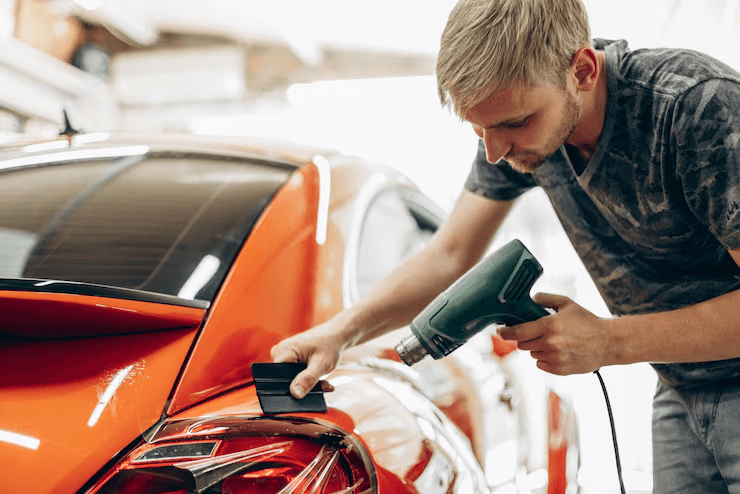
Here is what typically happens. The vehicle goes in for a thorough clean and surface preparation. Any existing contaminants, wax, or residue must be removed before the vinyl goes on, as adhesion depends on a clean surface. From there, the wrap is measured, cut, and applied panel by panel by a trained installer.
The timeline depends on the vehicle and the complexity of the job. A partial wrap covering just the hood and roof takes less time than a full vehicle wrap. A shop that does this well does not rush the process. Corners, curves, and edges require patience, and that patience shows in the final result.
After installation, there is usually a short settling period before washing the vehicle. Following that, maintenance is straightforward. Regular washing, keeping the vehicle out of harsh chemicals, and addressing any edge lifting early keep the wrap in good shape for years.
See also: Business Owners: Key Considerations for Ai Deployment
Why the Timing Makes Sense Right Now
Toronto’s automotive culture has shifted noticeably over the past few years. More drivers are treating their vehicles as extensions of their personal style rather than purely as transportation. The popularity of custom wheels, tinted windows, and lowered suspensions has been part of that shift for a while. Vinyl wrapping has joined that conversation in a serious way.
Wrap technology has also improved significantly. Early wraps had a reputation for bubbling, fading unevenly, or lifting at the edges after a season or two. The materials available now are considerably more durable, and installation techniques have become more refined as the trade has matured. A wrap done well today looks better and lasts longer than what was possible even five years ago.
For a Toronto driver sitting on the fence, perhaps the most honest thing to say is this. The question is rarely whether a wrap is worth doing. It is whether the shop doing it is worth trusting. That part of the decision deserves as much attention as the color or finish you choose.
Wrapping Up
Vinyl wrapping has gone from a niche modification to a mainstream choice for Toronto drivers who want protection, personalization, or both. The city’s roads give paint a hard time, and wrapping addresses directly. The creative options go well beyond what traditional paint allows. And the flexibility to change, remove, or update the look keeps the decision feeling low-risk even for first-timers. If you have been watching wrapped vehicles roll past you on the Gardiner and wondering whether it makes sense for yours, the answer for most drivers is probably yes.